Background Check opens a clear path to Illinois criminal‑history data, letting users pull arrest logs, misdemeanor and felony filings, or civil docket details in minutes. By entering a name, date of birth, or county, the online portal connects to the Illinois State Police Bureau of Identification, where conviction information is released under state law. This fast lookup supports hiring, tenancy, and personal safety decisions while respecting permissible‑use rules and consent requirements.
Background Check also empowers a deeper background information lookup, covering property deeds, marriage filings, and business records that shape a full background history search personal. Users can request official certified copies or resolve name‑match confusion through the state’s public records background check system. The service respects sealed or expunged file exclusions and guides callers on how to correct inaccurate entries, ensuring reliable results for any Illinois county search.
How to Search Background Check
A background check in Illinois starts with the Illinois State Police Bureau of Identification criminal-history service. In addition, consulting official kane county records confirms that it helps a requester find state criminal-history records and compare the result with court or county records. Each search should have a lawful purpose, such as employment or review of a specific official record. Illinois limits public criminal-history dissemination to conviction data, so an arrest report or complete case file may require a separate request to the agency that holds it.
Official Search Portal: https://isp.illinois.gov/BureauOfIdentification/CriminalHistory
Steps to Search
- Open the official Bureau of Identification criminal-history page and select the search method offered for the request type.
- Enter the person’s legal name and date of birth when requested. Use a county only with the local court, clerk, or recorder serving that area; it does not replace personal identifiers in the state search.
- Submit the query and compare every match using the name, birth date, case number, court, and event dates shown in the result.
- Read the response as a criminal-history record, not a complete case file. An arrest, a filed charge, and a conviction are separate events, and the public criminal-history response is limited to conviction data.
- Follow current official instructions for fees, delivery, and certified copies. Use the proper court, county, or state office for civil dockets, judgments, deeds, business filings, marriage filings, and birth or death records.
Background Record Search
A background check records lookup in Illinois often crosses several offices. The Bureau of Identification covers Illinois criminal-history data, while civil and criminal cases sit with court clerks, property records with county recorders, business filings with the Secretary of State, and birth or death records with public-health registrars. A public records background check should preserve these source boundaries instead of merging every entry into one profile.
Search Fields and Jurisdiction
The strongest search starts with an exact legal name and date of birth. County, state, address, and case number can narrow a local or multi-state search, but each field has a different purpose. Field availability depends on the custodian and record type.
Build a Complete Record Search
A full background history search uses each source for a clear purpose. A civil docket may identify claims, parties, hearing dates, and case status, but it may not contain the full contract, evidence, or settlement file. A deed index can locate a recorded property instrument without providing a current title opinion. A business filing can confirm an entity’s recorded name, file number, or status without showing its finances, tax position, or daily operations.
The source must match the question. Property ownership requires the county recorder, entity standing requires the Secretary of State, and a marriage filing belongs with the county clerk. Criminal-history data comes from the Bureau of Identification, and court dockets come from the clerk of the appropriate circuit. Combining those records can produce a fuller picture without assigning one record the legal effect of another.
Separate Criminal History From Court Records
A Bureau of Identification response can show conviction-level data reported to that agency, but it does not replace the court file. A criminal case may include complaints, pleadings, evidence, orders, sentencing records, and later actions that do not appear in the state criminal-history response. Review the court docket by case number whenever a filing, conviction, sentence, or correction needs confirmation.
A search that returns no match does not prove that no case exists. The person may use a different legal name, the case may belong to another jurisdiction, or the state may not have received the record. If a known case is missing, search the court docket first and then compare that filing with the Bureau of Identification response before requesting a record challenge.
Criminal, Court, and Property Data
Conviction records, court cases, property filings, and family records carry different legal meanings. Accurate labels help prevent a pending charge or recorded transaction from being presented as a conviction. Each section should state the source, the event date, and the document’s current status.
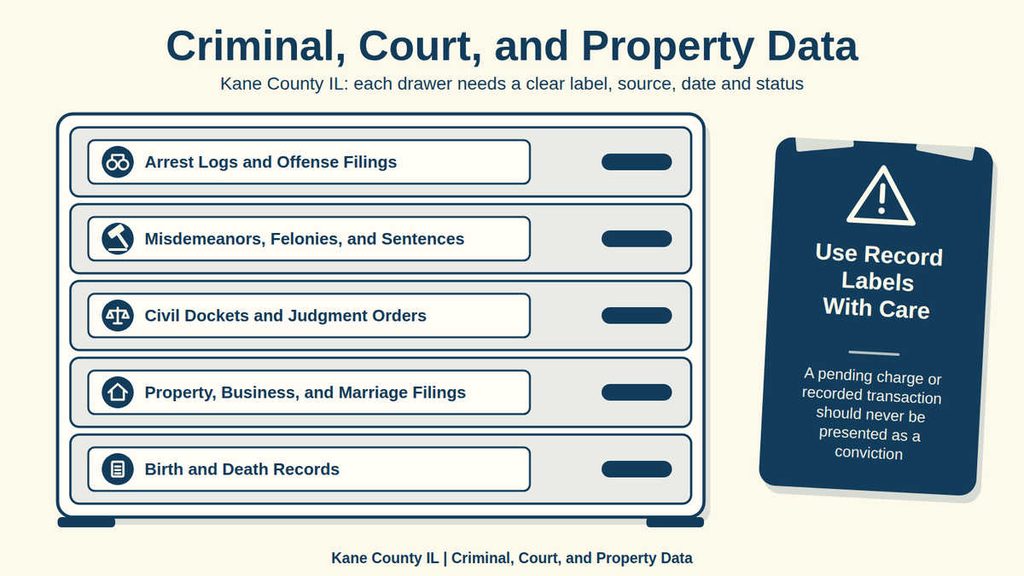
Arrest Logs and Offense Filings
An arrest log records that law enforcement took a person into custody. It does not prove that the person committed the alleged act or received a conviction. Police reports may contain investigative material, and public release depends on the agency and the law. A law enforcement blotter may show limited arrest data, but a complete police report is a separate record from a court file or state criminal-history response.
An offense filing shows that a charge was filed in court. A charge remains an allegation until the court resolves it through a dismissal, plea, judgment, acquittal, or another disposition. Keep arrest entries, filed charges, and convictions in separate fields so the final record does not overstate the result.
Misdemeanors, Felonies, and Sentences
The official Bureau of Identification page states that public dissemination under Illinois law is limited to conviction data. A returned record can contain conviction-level details and sentencing data to the extent included by the agency. It may not include every charge, witness statement, exhibit, or filing connected with the case.
The misdemeanor or felony label should come from the official disposition rather than a search user’s description. Sentencing data can include the sentence imposed, but a criminal-history response may not reproduce every judgment entry or later amendment. A person should request the court file when the full charge history, sentencing order, or correction history matters.
Civil Dockets and Judgment Orders
Civil cases are maintained by the clerk of the appropriate Illinois circuit court. A docket may show the case number, party names, filing date, assigned judge, hearing schedule, case status, and final judgment or dismissal. Judgment orders can then be requested from the same clerk. These records answer questions about filed claims and court actions rather than the merits of any settlement that remained private.
A docket entry is not the same as the complete file. Some documents may be unavailable online because of filing method, confidentiality, sealing, or a clerk’s copy procedure. For a lien, enforcement, judgment, or court filing, obtain the actual document rather than relying on a case-status line. A certified copy is often needed when another court or agency must accept the record.
Property, Business, and Marriage Filings
Property, business, and marriage records support a broader background history, yet they do not belong in a criminal-history response. Each record comes from a different office and answers a different question.
Birth and Death Records
The Illinois Department of Public Health and local registrars handle birth and death records. Copies and record availability can depend on the event date, the office holding the file, and the purpose of the request. These records can help confirm an identity or family event, but a birth certificate does not list every former name, address, or current location.
Marriage records are handled separately by the county clerk. A personal history review should label birth, death, and marriage records by their actual event and source instead of placing them beside criminal filings without an explanatory category.
Use Record Labels With Care
Plain labels reduce confusion: “filed charge,” “conviction,” “civil judgment,” “recorded deed,” “entity filing,” and “recorded marriage.” Each label states what the source documents. A background check records search built on those labels gives a decision-maker a factual basis without turning an allegation or administrative filing into a criminal finding.
Legal Compliance and Consumer Rights
A lawful background screening process follows the law controlling the record and the law controlling the employment decision. A direct state record request and a report supplied by a screening company can follow different procedures. The record source, intended use, and type of report should be identified before the search begins.
Permissible Use and Illinois Record Limits
The Illinois criminal-history statute, 20 ILCS 2630, and Illinois public-records law, 5 ILCS 140, govern access to and dissemination of criminal-history records. The Bureau of Identification’s official page states that public dissemination is limited to conviction data. Every requester should follow the current authorization, identity, fee, and delivery instructions shown for the selected search method.
A screening decision must fit a purpose permitted by applicable law. Sensitive records should not be reused for harassment, public posting, or unrelated decisions. A signed authorization permits a particular request; it does not remove record limits or allow the recipient to redistribute the result outside the permitted purpose.
Applicant Consent and Illinois Employment Rules
Consent depends on which system creates the result. Federal consumer-report law, Illinois employment law, and state criminal-history rules can apply to the same hiring process without serving the same function.
Third-Party Consumer Report Rights
A third-party consumer report is separate from the government file that supplied the data. Under the Fair Credit Reporting Act, a person may request the report with proper identification and may dispute its accuracy. After an adverse-action notice, the federal procedure provides a 30-day period for a qualifying dispute. A consumer reporting agency must investigate and correct or remove data shown to be inaccurate or unable to verify.
A dispute filed with a screening company does not change a court order, state record, deed, or business filing. The dispute must also go to the custodian that created the source record. Keep the report, the adverse-action notice, the proof of submission, and the agency’s response so each stage remains traceable.
Official Record Correction Rights
For an Illinois criminal-history error, request the Bureau of Identification’s current criminal-history record challenge process and submit accurate identity details plus supporting case records. For public reference, official people search listings indicate that a court disposition, case number, or certified order can help the agency locate the correct entry. If a valid case is missing, include proof of the case and its status with the challenge.
A court-record error belongs before the judge or court that handled the case; a clerk cannot replace a judicial order by making an administrative change. A deed error belongs with the county recorder, and a business-filing error belongs with the Secretary of State. Retain copies of each source record, submission, and written response because each custodian resolves only the records within its authority.
Public Availability and Official Copies
Public availability differs by record, custodian, and document status. An online index, a search response, an ordinary copy, and a certified copy serve different purposes. “Public” describes a record’s legal status; it does not mean that every document is online, complete, or free of charge.
Requesting Official Agency Copies
Use the request method created by the custodian that holds the record. The Bureau of Identification page gives current criminal-history request, fee, delivery, and certification instructions. A circuit clerk handles court files and certified court documents. A county recorder handles recorded property instruments, the Secretary of State handles business filings, and public-health registrars handle birth and death certificates.
A third-party background check summary cannot replace an official copy. It may combine several public sources, apply its own matching method, or show only a limited record profile. When a decision, filing, correction, or identity check depends on exact wording, request the document from the issuing agency.
Certified File Documentation
A certified copy is authenticated by the custodian of the record. It confirms that the copy corresponds to the record held by that office. A search-screen printout or vendor summary is not certified unless the issuing source expressly states that it is. Even a certified copy contains only the documents requested and listed.
Sealed, Expunged, and Juvenile Exclusions
Sealed material is withheld from ordinary public view. A docket may show a sealed status without showing the protected document, and the clerk or court can explain the filing’s current status. An expungement order can change what the Bureau of Identification disseminates once the agency processes that order. If a listing remains after an expungement, submit the certified order with a record challenge.
Juvenile records follow separate confidentiality and release rules and are not part of an ordinary adult criminal-history response. Non-conviction material also falls outside the ordinary public criminal-history limit. These exclusions help explain why a no-record result may differ from the person’s complete history. They do not erase the event from every court or agency file.
Record Accuracy and Resolution
A background check lookup should create a traceable record of each query and result. Record the source, date searched, identifiers entered, matching data, and any copy received. This audit trail supports later verification, correction, or a lawful decision based on current official records.
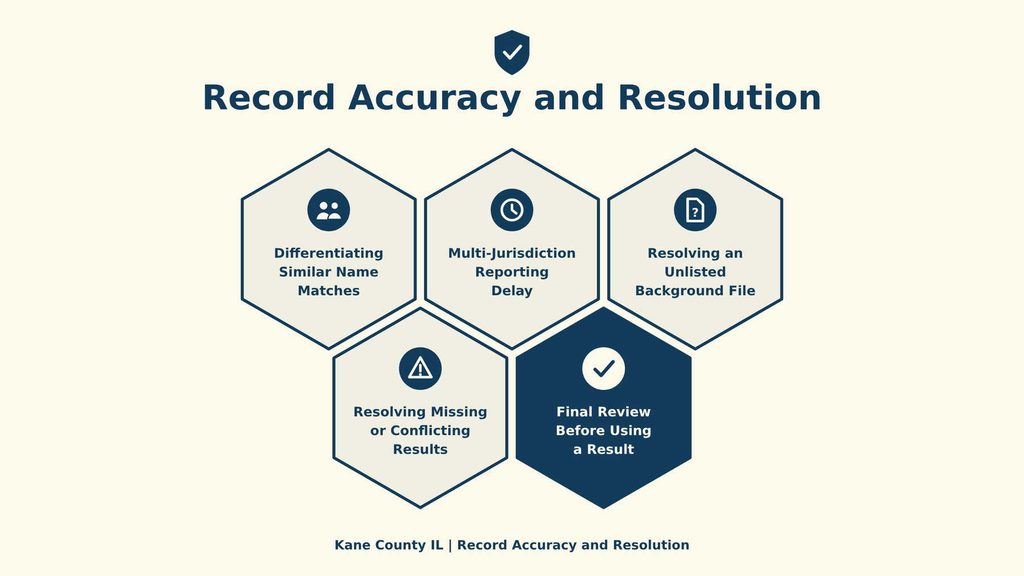
Differentiating Similar Name Matches
A shared name is weak evidence of identity. Compare the birth date, middle name, suffix, case number, court, event date, and disposition whenever the source displays them. An address can help with identity matching when it appears in the record, but it should never serve as the sole identifier. Names also change, so a prior legal name connected to court records may produce a better match than a current name.
Reject a match when a reliable identifier conflicts. Do not attach a conviction, civil claim, judgment, deed, or business filing to a person based on name similarity alone. If the source lacks enough matching data, request the underlying record and compare it with the person’s identity documents through a lawful process.
Multi-Jurisdiction Reporting Delay
An Illinois criminal-history response reflects data reported to the state system; it is not a live index of every case in every Illinois county, another state, or a federal court. Reporting can occur on different schedules, and some local records may not reach the state repository. Data from another state may enter an Illinois record only if it is reported through the applicable system.
A person’s address history can point to other states and counties. Run a separate official search for each relevant jurisdiction and check the court dockets where events occurred. A no-record result in Illinois should never be described as a nationwide clearance or proof that no record exists elsewhere.
Resolving an Unlisted Background File
Begin with the known case number, court, event date, and party name. The clerk’s docket can confirm the case status, charges, disposition, and judgment even when the criminal-history response does not show it. If the Bureau of Identification has no matching entry, submit its current record challenge form or request process with the supporting court record.
When no case number is known, rerun the search with the exact legal name and birth date shown on older documents. Middle names, suffixes, and documented prior names can help when they come from lawful identity records. Avoid guessed name variants because random combinations can create false matches. Preserve each query and result so the search history remains clear.
Resolving Missing or Conflicting Results
A conflict between two sources should not be settled by choosing the preferred result. Compare the exact identifiers, event dates, and documents from each custodian. A certified court docket or judgment can confirm what happened in the case; a Bureau of Identification record challenge can address a missing or incorrect state entry; and a consumer-report dispute can address a vendor’s file.
If the official record shows an error that affects a decision, pause the decision until the correction path is complete. A no-record result can reflect no reported conviction, an identity mismatch, a reporting delay, a sealed or expunged file, a juvenile exclusion, or an agency error. The source record and the reason for each exclusion should be documented rather than guessed.
Final Review Before Using a Result
Confirm that the legal name and birth date match, the case number belongs to the correct court, and the document describes the event instead of an allegation. Separate arrest records, filed charges, convictions, civil claims, judgments, and administrative filings. Any result used for a consequential decision should come from the custodian or a properly obtained certified copy, with any correction request resolved before the decision proceeds.
Contact Information
Use the Illinois State Police contact page for Bureau of Identification criminal-history request questions, record challenges, and agency-specific delivery or correction instructions. The department can provide information about available request procedures and applicable requirements. Review the contact details before submitting an inquiry to the appropriate unit. Include relevant reference numbers when available to help direct your question. For current instructions, rely on information published through the Illinois State Police website.
- Address: 260 North Chicago Street, Joliet, IL 60432-4075
- Phone: (815) 740-5160
- Office Hours: Monday–Friday, 8:00 AM–4:00 PM
- Official Portal: https://isp.illinois.gov/Home/ContactISP
Frequently Asked Questions
Background checks help employers, landlords, and individuals verify a person’s criminal history, address history, and other public records. In Illinois, the State Police Bureau of Identification supplies conviction data that can be accessed online or by request. Using these records protects safety, supports hiring decisions, and ensures compliance with state regulations. The service works best when users have a clear, lawful purpose and follow the required steps for a valid search.
How can I perform a background check by name in Illinois?
Start at the Illinois State Police Bureau of Identification website. Enter the full name, date of birth, and any known aliases. Pay the required fee and submit the request. Results will list convictions that are public under Illinois law. Verify the information against county court records for accuracy before making a decision.
What information does a background check search return?
The report includes felony and misdemeanor convictions, the court where each case was heard, and the date of conviction. It does not show arrests without convictions, sealed records, or pending cases. Some reports also note the jurisdiction and the offense description, helping users understand the relevance of each entry.
Can I look up background records by address or county?
Yes. On the ISP portal, choose the “search by address” option. Input the street, city, and ZIP code, then select the county. The system returns all individuals with convictions linked to that address. This method is useful for landlords checking tenant histories or investigators confirming residency.
How do I conduct a background screening for employment?
First, confirm that the job role requires a criminal‑history check under state law. Request the candidate’s consent in writing. Use the ISP criminal‑history service or an approved third‑party vendor that accesses the same data. Review the conviction list, compare it to the job’s safety requirements, and document the decision in the hiring file.
What steps should I follow if I need a background check record search for a specific date of birth?
Visit the ISP criminal‑history page and select “search by date of birth.” Enter the full birth date and, if possible, the person’s full name. Pay the fee, then wait for the electronic report. The output will list any convictions tied to that birth date, allowing you to verify identity when names are common.
Is it possible to get a public records background check online for free?
Illinois limits free access to conviction data. Some county clerk sites let you view recent court filings without charge, but they rarely include full criminal histories. For complete, statewide records, a paid request through the ISP or an authorized vendor is required. Avoid sites that promise free, comprehensive reports, as they often violate state privacy rules.